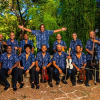
Lehman Center for the Performing Arts is proud to present direct from Cuba, the legendary champion of cha-cha-cha and danzón, ORQUESTA ARAGÓN, and the great charanga band, ORQUESTA BROADWAY, onSaturday, May 13th, 2017 at 8pm. Orquesta Aragón, still fabulous after it was formed nearly eighty years ago, internationally spearheaded the first wave of Cuban cha-cha-cha and mambo mania that captivated American audiences. The New York based Orquesta Broadway is celebrating more than 50 years as one of the most popularcharanga-style bands, a form of Cuban dance music, first popularized in the 1940s that combines classical musical instruments with African rhythms. Produced by Lehman Center and Leo Tizol.
Lehman Center for the Performing Arts is on the campus of Lehman College/CUNY at 250 Bedford Park Boulevard West, Bronx, NY 10468. Tickets for ORQUESTA ARAGÓN & ORQUESTA BROADWAY on Saturday, May 13th, 2017 at 8pm are $100*VIP, $65, $55, $50 and can be purchased by calling the Lehman Center box office at 718-960-8833 (Monday through Friday, 10am–5pm, and beginning at 12 noon on the day of the concert), or through online access at www.LehmanCenter.org. *New This Season: HAVANA CAFÉ and Lehman Center special VIP pre-concert wine & hors d’oeuvres reception starting at 6:30pm. VIP tickets include the reception and the best seats in the house. At the reception meet other patrons and the staff of Lehman Center. Sponsored by Havana Café Restaurant and Havana Club Puerto Rican Rum. Lehman Center is accessible by #4 or D train to Bedford Park Blvd. and is off the Saw Mill River Parkway and the Major Deegan Expressway. Low-cost on-site parking available for $5.
ORQUESTA ARAGÓN was founded in Cienfuegos in the Cuban province of Las Villas in 1939 by double bass player Orestes Aragón Cantero. Orquesta Aragón’s salon style of Cuban dance music called danzón, with their instrumentation of violins, flute, piano, bass, vocals and percussion, became so popular in the 1940’s, that the band was able to break into the Havana music club scene by the early 1950’s. Now led by virtuoso violinist Rafael Lay(who took over as leader upon Orestes Aragón’s retirement in 1948), Orquesta Aragón featured a line-up of musicians that have become legendary in Cuban Music: Richard Egües (flute), Panchito Arbolaez (guiro), Pepe Palme (piano), Guido Sarria (congas), José Beltrán (double bass), Celso Valdés (violin), Orestes Varona(timpani), and Felo Bacallao and Pepe Olmo (vocals). In 1953, as the mambo era was taking hold in Havana and New York City, composer Enrique Jorrín and Orquesta Aragón developed a more dancer-friendly form of thedanzón-charanga called cha-cha-cha, which echoed the basic clave rhythm of 1-2, 1-2-3 (un-dos, cha-cha-cha). They recorded “El Agua de Clavelito”, which became the big hit at Santiago de Cuba’s carnival in 1954.Through out Cuba, and the world, cha-cha-cha rapidly became synonymous with “Aragón”. “El Bodeguero” became their first international big hit and was covered by Nat King Cole in 1956 during his Havana sessions. Hits like “Los Maricnos”, “El Rico Vacilôn”, “Para Cochero”, “El Paso de Encarnación”, “Cero Codazos, Cero Cabezazos”, “Cachita” and “Los Tamalitos de Olga” followed in quick succession and the band began touring frequently in the U.S. and the Caribbean. Their prodigious output of hit singles were released on numerous albums including That Cuban Cha Cha Cha (1990) and The Heart of Havana Vol. 1 & Vol. 2 (1992). The establishment of Fidel Castro’s government on January 1st, 1959 did not slow them down, although their touring to the U.S. was embargoed. That year the band was number one in Cuba’s Radio Progreso hit parade with the cha-cha “Cuba Cubita Cubera”. In 1965, Orquesta Aragón participated in the legendary Music-Hall de Cuba Tour of 100 Cuban musicians, playing in France, Germany, Poland and the U.S.S.R. This was at a time when rock ‘n’ roll and the Twist were at the height of popularity and Orquesta Aragón recorded several rock and twist-inspired cha-chas (shake) that met with great success. In 1978, they were allowed to return to the U.S. and performed at New York City’s Lincoln Center. That concert was released as the album Recorded Live in New York.
Over the years, Orquesta Aragón’s line-up has changed with the sons of the original musicians replacing their fathers when they have retired. Rafael Lay Jr. now leads the band as first violin. Violinists Dagoberto and Lazaro González are father and son. Current member Ernesto Bacallao is the son of Felo Bacallao, and José Palma is the son of Pepe Palma. In 1997 the band released Cha Cha Charanga, and followed up with Quién Sabe Sabe(1998) which breathes fresh life into standards such as “Si Sabes Bailar Mi Son”; La Charanga Eterna (1999) which celebrated their 60th anniversary and included “El Paso de Encarnacion” and the classics “Siboney” and “Bruca Manigua”; and En Route (2001) which contains the masterly danzón “Si Envida” and the chaonda “A Bailar mi Cha-onda”. Aragoneando (2016), their most recent release was nominated in the Best Traditional Popular category of the Cubadisco Awards. For almost eighty years, Orquesta Aragón have set the standard for Cuban dance music with their sweet melodies, infectious rhythms and rich harmonies.
ORQUESTA BROADWAY is a Cuban charanga style band that was founded in New York City in 1962 by flautistEddy Zervigón and his brothers Rudy (violin) and Kelvin (piano) along with their neighbor Roberto Torres as their vocalist. Eddy was born in Güines, Cuba and originally played the piccolo before switching to the 5-key wooden ‘French flute’ in 1955. He chose the wood flute because in charanga, the flautist must “improvise at all times” and at the higher register on a metal flute, you cannot create as many sounds. Eddy played in several bands in Cuba with his twin brother Rudy before moving to Miami in April of 1962 for four months with his band Ritmo De Estrellas. He then relocated to West 135th Street in Manhattan where he worked with Johnny Pacheco, Arsenio Rodríguez, Joe Valle, Lou Pérez, Alfredito Valdés and Pupi Legarreta and his Charanga and others before forming his own band, Orquesta Broadway, which debuted in October 1963 at NYC’s Palladium concert hall. Charanga is an instrumental format of Cuban origin developed at the end of the 19th century consisting of flute, violins, bass and a rhythm section composed of tumbadora, timbale, güiro and singers. Most recently, Orquesta Broadway was the 2013 over-all winner of Colombia’s prestigious Congo de Oro Award.
Orquesta Broadway’s first album Dengue was released in 1964 and contained the cha cha hit “Como Camina Maria”. Their next four releases, which included Arrímate Pa’ Acá (1965) and Tiqui, Tiqui (1966) solidified their popularity as one of New York’s top bands. 1972’s album Cómo Me Gusta! Contained the hit “Pa’ Africa” which inspired Orquesta Broadway to perform in Côte d’Ivoire, Senegal and Europe the following year. Between 1975 and 1981, they released four more albums, and one of them Pasaporte (1976) was so popular, they became NYC’s busiest band, playing an average of 15 dances a week. The band continues to release albums on a regular basis and their La Charanga Que Manda/40 Aniversario was nominated for the 2003 Latin Grammy Award. In February, 2013, Orquesta Broadway added to their long list of accolades by wining the Congo de Oro for best orchestra at the International Carnival in Barranquilla, Columbia. Now, more than fifty years after its foundation and despite changing music styles, the always-in-demand Orquesta Broadway continues to enjoy an enviable position at the forefront of Afro-Cuban and Latin music in the country.
Lehman Center for the Performing Arts, Inc. is supported, in part, with public funds from the New York City Department of Cultural Affairs in partnership with the New York City Council. The 2016-2017 Season is made possible by the New York State Council on the Arts with the support of Governor Andrew Cuomo and the New York State Legislature. Additional funding is provided by Con Edison, the New Yankee Stadium Community Benefits Fund, the Rudin Foundation, the Hyde and Watson Foundation, and the friends of Lehman Center.
For high resolution photos, click these links:
Orquesta Aragón
http://lehmancenter.org/th_gallery/orquesta-aragon/
Orquesta Broadway
http://lehmancenter.org/th_gallery/orquesta-broadway-2/
show less