Alex Coke
:
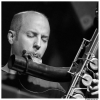
born in Dallas, Texas (1953), received his B.A. from the University Of Colorado at Boulder in 1976, with emphasis on flute performance.
An original member of the Austin-based Creative Opportunity Orchestra, Coke performed with Tina Marsh in various formations for over 30 years. Before moving to Amsterdam in the early '90's he received several awards including:
1990 Best Saxophonist, Music City Critics Poll/Austin Texas
1990
Best Jazz Bands Music City Critics Poll/Austin Texas
(Countenance #1, and Worthy Constituents
#3)
1990 Best Unsigned Bands Musician Magazine
(Countenance, and Worthy Constituents)
1988-1989 Best Jazz Band, Austin Chronicle Music Awards
(Chris Duarte and Justus)
.
From 1990-2000 he toured and recorded with the internationally renowned Dutch jazz group, the Willem Breuker Kollektief.
An improvisor at heart, Coke's eclectic attitude has led him to
explore everything from Be-Bop to Huddie Ledbetter.
His flute studies have ranged from Eric Dolphy, Sam Most, and Rahsaan Roland Kirk to Indian ragas on the bamboo flute and extended flute techniques such as those researched by Robert Dick, Ann LaBerge and Wil Offermans.
He has worked with Screamin' Jay Hawkins, Gerald Wilson, Charles Tolliver, the Paradise Regained Orchestra, Alejandro Escovedo, Oliver Rajamani and the Trio Henk de Jonge. He can also be heard with the John Jordan Trio, the Mysterious Quartet From Helsinki featuring Chris Duarte, Rob Verdurmen's Double Drummer Bill, Greezy Wheels CD HipPOP, Abraham Inc..
Coke's recent release, entitled "It's Possible" features long time collaborators Tina Marsh/vocals and Steve Feld./ashiwa bass box
Ned McGowan:
"McGowan's music strives for an idiom in which various musics – American popular, European classical and avant-garde, Carnatic, a fascination with proportionally intricate rhythms, the use of microtones in the search for new subtleties of melody – and many others, rub against each other and generate new meanings."
This is how musicologist Bob Gilmore describes composer and flutist Ned McGowan.
Born in the United States in 1970 and living in the Netherlands since 1994, McGowan has built his career by collaborating closely with ensembles such as the Axyz Ensemble, Calefax, the Spinifex Orchestra, pianoduo Post & Mulder and Hexnut.
His taste for diversity emerged already as a teenager who took classical flute lessons, played jazz and listened to rock. After finishing studies in flute at the San Francisco Conservatory and the Cleveland Institute of Music, he moved to Amsterdam to continue his research. Over the course of eight years, he studied both flute and composition in Amsterdam and The Hague, exploring a wide range of subjects – from extended techniques to Carnatic forms and rhythms, from jazz improvisation to West-African drumming. His compositional voice was profoundly influenced by these experiences, even though he never directly follows any of these traditions stylistically.
Then, in 2007, his specific fascination with Carnatic music led to a series of extended stays in India studying performance, rhythm and composition.
"What fascinates me is the Carnatic use of rhythmical complexities developed through a tradition of performance."
This is clear in McGowan's music, and emerges in his strong focus on rhythmically driven, technically virtuosic pieces, which while "very complex in many ways, are especially well put together" (Hans van Lissum, www.cut-up.com, 2007).
Another approach to his Indian influence can be heard in the long stretched out phrases in Sound becomes visible in the form of radiance, the piece he wrote in 2010 as winner of the Harvey Gaul competition from the Pittsburgh New Music Ensemble: "a radical work that reorients the listener's relationship to time." (Mark Kanny, Pittsburgh Tribune, 2010)
But despite whatever complexity McGowan might write, his music is never bookish; it is written with both the performers and the listeners in mind. In his debut in Carnegie Hall with the American Composers Orchestra, he "proved there's still plenty of life in old-fashioned virtuosity with "Bantammer Swing," a playful, athletic concerto for his unwieldy contrabass flute," according to Steve Smith of the New York Times.
Similarly, Ned's piece Tools, winner of the Henriette Bosmans Prize from the Dutch Composer's Union GeNeCo, was described as "brutal and humorous" (GeNeCo, 2004), while at the same time "packed with discreet acoustic rooms, some more resonant than others, but all proving that... subtlety pays off" (Guy Livingston, Paris Transatlantic, 2006).
Bantammer Swing and Tools are only some of pieces that have come into the public eye: Melting Igloos and Moonriseboth made it to the final of the Gaudeamus Competition Prize. "Wood Burn [written for Calefax] grew to be the highpoint of the evening" (Mark van de Voort, the Brabants Dagblad). These and other compositions have been played throughout Europe, North Amercia and Australia, and at MATA Festival (New York), Ought-One (Vermont), Aspen Music Festival (Colorado), The American Music Week in Bulgaria, the Gaudeamus Music Week, the North Sea Jazz Festival, the Klap op de Vuurpijl, the Grachten Festival and the Karnatic Lab Festival (Amsterdam). Ensembles and festivals that have commissioned McGowan include the American Composers Orchestra, Dutch Radio Chamber Orchestra (NPS / Dutch Music Days), the Zephyr String Quartet, Calefax reed quintet, the Axyz Ensemble, Duo Vertigo, the Netherlands Flute Orchestra and Hexnut (Grachten and MATA festivals).
Current commissions include the Rotterdam Sinfonia, Spinifex Orchestra, Trio Scordatura, Wervelwind, Fluit/Harp Duo and a European/Indian translation of Monteverdi's L'Orfeo.
Ned is also highly active in fostering the Amsterdam musical community through the Karnatic Lab Foundation, an organization he founded with Gijs Levelt in 1999 to promote both composed and improvised new music.
Going strong after ten years, this Karnatic Lab runs a monthly concert series, has its own record label (Karnatic Lab Records) and house several ensembles, including McGowan's own quintet,Hexnut.
Hexnut is his special group that grew out of the original instrumentation for his piece Tools, plus a singer. They are "a tribe of dedicated musicians who perform the most fiendishly difficult rhythms with flair and ease…" (Paris Atlantic). The band reflects Ned's affinity for the edgy, risky and yet extremely precise – the embodiment of "brutal and humorous." It is a perfect example of the juxtaposition, assimilation and contradiction of styles within improvisation and composition that Ned is constantly inventing. In Hexnut, Ned is often seen behind his contrabass flute, which has become one of his specialties.
Starting in 2011 Hexnut is presenting a new project in collaboration with the photographs from the Canadian photographer Edward Burtynsky.
Also in the mix are his more academic activities: since the 2009 Ned teaches his own Carnatic Practices course to masters students at the at the Conservatory of Utrecht.
Previous institutions he has taught at include the Conservatory of Amsterdam and the Amsterdamse Hogeschool voor de Kunsten. Between 2000 and 2005, he was also the director of the Dutch microtonal institute, theHuygens-Fokker Foundation, and now resides on its board.
Arjen Gorter:
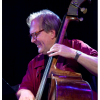
Arjen Gorter (2 januari 1948, Amsterdam, The Netherlands) played accordeon at age 8, guitar at 12 and double bass from age 16. He is self-taught, but for a few months of classical bass lessons and two semesters of jazz workshops with Theo Loevendie.
He graduated from the Barlaeus Gymnasium and studied political science and sociology at the University of Amsterdam, until becoming a full-time musician in early 1970.
In 1966 he participated in the 18-piece orchestra with which Willem Breuker caused upheaval at the Loosdrecht Jazz Festival, together with Ileana Melita, Gilius van Bergeyk, Hans Vonk, Jan Wolff and others.
From 1967 through 1971 active in various groups led by Gunter Hampel with a.o. Jeanne Lee, Anthony Braxton, Steve McCall en John McLaughlin, at festivals in Germany, Belgium, France, Italy and Yugoslavia.
During the first half of the 1970's free-lance contrabassist, for example in groups led by Chris McGregor (Paradiso, Amsterdam), John Stevens (Spontaneous Music Ensemble, Berliner Jazz Tage), Gato Barbieri (Bilzen Festival, with Han Bennink) en Paul Bley (Chateauvallon, with Steve McCall).
Member of the Irene Schweizer/ Rudiger Carl Quartet 1972-1975, with a.o. Louis Moholo. In The Netherlands work with Boy Edgar, Loek Dikker, Hans Dulfer & Ritmo Natural, Herman de Wit and the Instant Composers Pool, ICP.
From 1972 through 1985 cooperation with composer/saxophonist Theo Loevendie in his Consort and Quartet; bassist in groups with Nedly Elstak (e.g. Several Singers) between 1978 and 1984.
From the founding in 1974 until the move in 2005 involved in the organisation behind the BIMhuis in Amsterdam; for twelve years board member of the Union of Improvising Musicians BIM; six years as member of the Dutch Arts Council (Raad voor de Kunst).
Arjen is a member of the Willem Breuker Kollektief from its founding in 1975 on and traveled with this ensemble all over the world, including multiple tours of Russia, China, Japan, India, Indonesia en Australia and some twenty tours through the United States.
Besides, through the years, he is active internationally as free lance contrabassist/improviser, performing together with musicians ranging from Jemeel Moondoc to Phil Woods, from Sheila Jordan to Suzie Stern and from Rene Thomas to Pere Soto.
He was bassist for the Mal Waldron European Quartet, with John Betsch and Sean Bergin, until Waldron's death in December 2002.
Since the millennium he performed with Craig Handy, Alex Coke, Archie Shepp and James Carter and with the Eric Dolphy 2000 Project (with Breuker, John Engels and Eric Vloeimans). With Toby Delius, Michael Moore and Martin van Duijnhoven he plays in the Frank van Bommel Quintet, which toured Canada in 2003. He also is part of Drummers Double Bill, an octet led by Rob Verdurmen and Arend Niks that toured in Holland and China.
show less