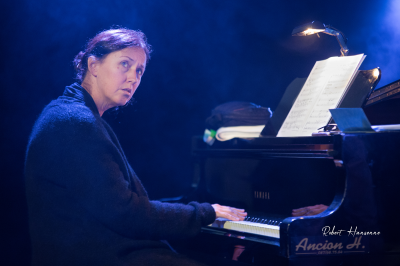
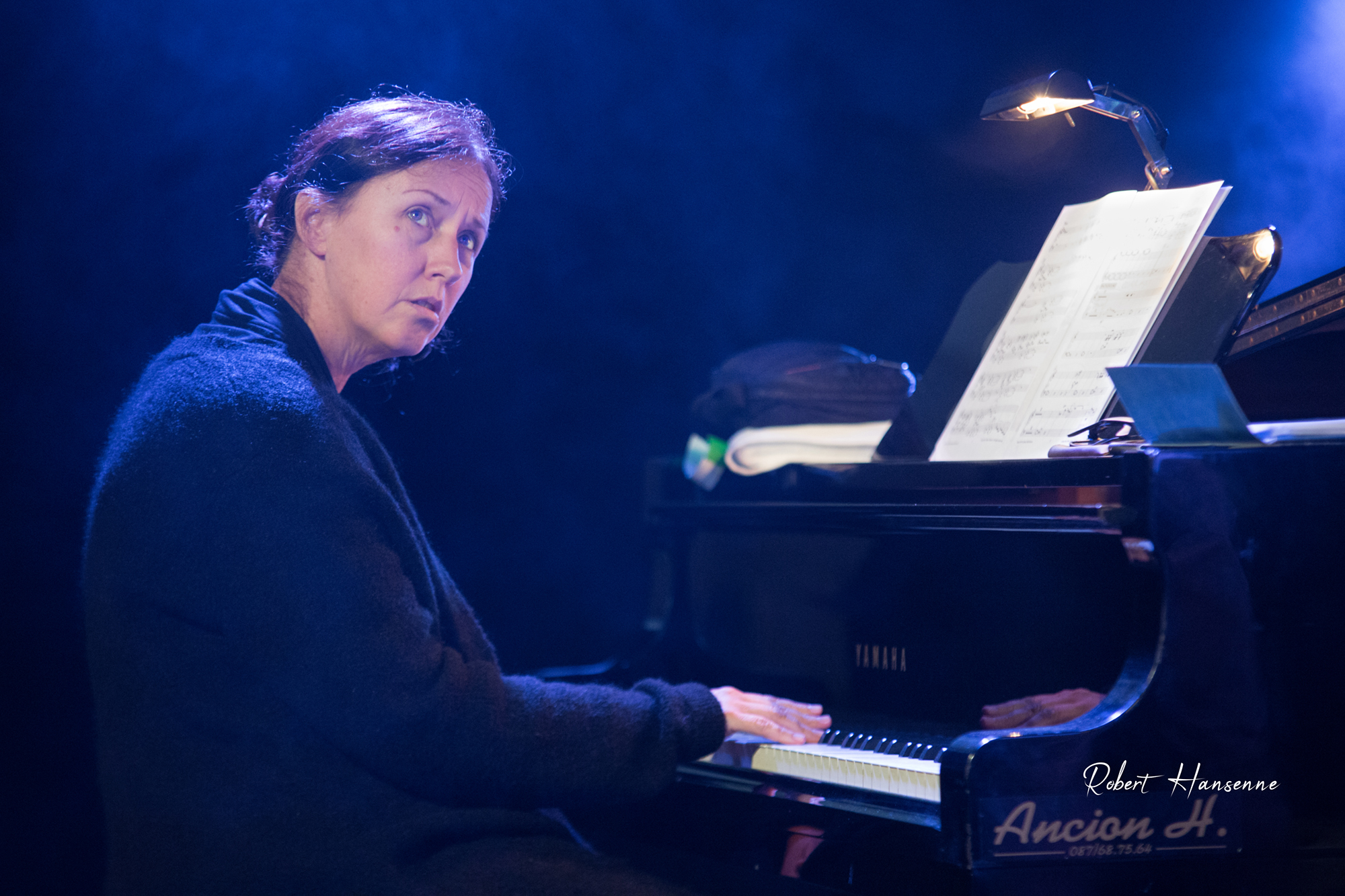
When Nathalie Loriers appeared on the jazz scene in the late 1980s, she must have felt very alone as a woman. In the Dictionnaire du Jazz à Bruxelles et en Wallonie (Dictionary of Jazz in Brussels and Wallonia), published in 1991, the fifty-page historical introduction does not mention a single female instrumentalist, or even a female singer. The dictionary entries themselves list fewer than ten female jazz musicians. The pianist, originally from Namur, paved the way for future generations.
While her status as a woman in such a male-dominated environment may have aroused interest in her, it was her talent as a musician that quickly made the difference. This was evident in the 1990s, when she regularly won awards in Belgium and abroad and collaborated with big names such as Lee Konitz, Cameron Brown, Philip Catherine and Toots Thielemans. At the age of 25, she recorded her first album under her own name, and her discography now includes a dozen. Alongside her career as a leader, in 2002 she became the pianist for the Brussels Jazz Orchestra, which now enjoys a worldwide reputation....
read more
When Nathalie Loriers appeared on the jazz scene in the late 1980s, she must have felt very alone as a woman. In the Dictionnaire du Jazz à Bruxelles et en Wallonie (Dictionary of Jazz in Brussels and Wallonia), published in 1991, the fifty-page historical introduction does not mention a single female instrumentalist, or even a female singer. The dictionary entries themselves list fewer than ten female jazz musicians. The pianist, originally from Namur, paved the way for future generations.
While her status as a woman in such a male-dominated environment may have aroused interest in her, it was her talent as a musician that quickly made the difference. This was evident in the 1990s, when she regularly won awards in Belgium and abroad and collaborated with big names such as Lee Konitz, Cameron Brown, Philip Catherine and Toots Thielemans. At the age of 25, she recorded her first album under her own name, and her discography now includes a dozen. Alongside her career as a leader, in 2002 she became the pianist for the Brussels Jazz Orchestra, which now enjoys a worldwide reputation.
The trio remains his preferred format, and the press has often praised his compositions, the lyricism of his playing, and the finesse of his rapport and listening with his partners. These aspects bring him close to a certain Keith Jarrett. Discovered through his work with Charles Lloyd and then Miles Davis in the 1960s, Jarrett quickly became a true star. His breakthrough came in 1975 with ‘The Köln Concert’, a double live solo album that became the biggest seller for the then fledgling ECM label. It was the jazz record to have in your collection, even if you weren't a jazz fan, just as Pink Floyd's ‘The Dark Side of the Moon’ was for people who weren't particularly into rock music at the time.
Let's not oversimplify things, though: it wasn't just this album that earned Jarrett a special place in the history of solo piano. He also occupies a special place in the history of the trio, which he formed with Gary Peacock and Jack DeJohnette in 1983. This group, which was initially intended to be short-lived, performed for thirty years, with an original take on the standard repertoire.
Standards, improvisation, but also personal compositions that are less often mentioned: at every level, the American pianist is a musical genius. This is all the more appreciated now that illness prevents him from playing.
Live
Nathalie Loriers will perform alongside double bassist Sam Gerstmans.
MASTER CLASH
The observation :
"Miles Davis? I listened to a record, I didn't really like it...‘. It's possible to miss out on an artist, even an iconic one, just like that. Or to find yourself lost in the often abundant discography and profusion of sources available today via the internet. Despite appearances, approaching the work of a ’big name" is not as straightforward as it seems.
The concept :
Master Clash invites a jazz musician to share their passion for a renowned musical personality. How? By highlighting their uniqueness, their particularities and their influence on sound, instrument, playing, style, a movement, an era... The aim is to enable discovery or increase the listening pleasure of an audience interested in music without being specialists.
The pitch :
The evening offers the equivalent of two sets.
The first part features audiovisual archives showcasing the musical personality, with commentary by the guest during a discussion with Jacques Onan (Maison du Jazz).
The second part features a live performance by the guest related to the musical personality.
photo: © Robert Hansenne
show less